
History
Lohagad has a long history with several dynasties occupying it at different periods of time: Satavahanas, Chalukyas, Rashtrakutas, Yadavas, Bahamanis, Nizams, Mughals and Marathas. Chatrapati Shivaji Maharaj captured it in 1648 AD, but he was forced to surrender it to the Mughals in 1665 AD by the Treaty of Purandar. Chatrapati Shivaji Maharaj recaptured the fort in 1670 AD and used it for keeping his treasury. This fort was used to keep the winnings from Surat. Later in Peshwa time Nana Phadnavis used this fort for living for some time and built several structures in the fort such as a big tank and a step-well.
Geography and Climate
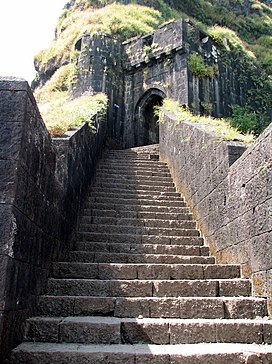
Lohagad is part of the Western Ghats. It rises to an elevation of 1,033 m (3,389 ft) above sea level, and is located to the southwest of the larger Visapur fort. The range divides the basins of the Indrayani river and Pavana lake. Lohagad overlooks the Pavana reservoir, located to the south of the mountain. The hill extends to the northwest to a fortified spur, called Vinchukada (Scorpion’s tail) because of its resembling shape. The four large gates of Lohagad are still in good condition and reasonably intact.
During the monsoon, the top of the fort is covered with mist and clouds and becomes particularly wet with growing moss. The roads and trails leading to the hill are quite slippery at this time of the year and precautions are necessary to be taken while venturing the routes.
Lohagad fort is one of the numerous hill forts situated in Maharashtra state, India. Interestingly, this fort rises to an elevation of about 3,388 feet high and is located near the hill of Lonavala and Pune to the northwest.
For the majority of the time, this fort was under the Maratha Empire and under the Mughal Empire was a few years.
Lohagad, or the iron fort, has had a long history with many dynasties having their period of occupation. Some of the dynasties who have occupied this fort include Chalukyas, Marathas, Nizams, Mughals, and many more.
Amazingly, this fort has had a lot of uses that are unique to rulers who occupied it, like keeping treasury and even living.
Importance of the fort
This fort has an immense historical significance and abode of archaeological beauty and has been used by various rulers in the past for various duties. Another importance of the past century is that the fort was among the many forts that Chhatrapati Shivaji had to hand over because of the Purandar Treaty.
However, as the ruler went on a mission of recapturing the forts, Lohagad also came under his bastion, becoming part of his major achievements.
Battles fought at the fort
Chhatrapati Shivaji was the founder of the Maratha Empire which is legendary in the history of India. Some battles were fought resulting in handing over or recapturing of the fort. Here are some of the battles fought;
• Battle of Mysore plateau
• Battle of Sinhagad
• Battle of Surat
• Battle of Poona
Tourist attraction
Lohagad fort is situated at the topmost of a hill and getting it is advantageous in seeing structures like temples, and lakes. Amazingly, visiting during the monsoon will let one see waterfalls, both small and huge.
However, during this monsoon season, extra care is needed because of the slipperiness of the moss. while at the top of the fort, one will get a clear view of the valley. Also, it is easy to get a good look at neighboring dams. Moreover, it is possible to see Bhaja and Karla caves while at the top.
How to reach
The fort is about 5 km away from the passenger train stop of Malavli on the Mumbai to Pune rail route. From the railway station you can hire a shared Auto, However, hiring a car in Pune or Mumbai and having a drive to the base of the fort is amazing.
Both Mumbai and Pune are near the fort since they are approximately 90 and 55 kilometers away respectively.
Nearby attractions
Bhaja Caves – 2 km (1.2 mi) from Malavli, once home to Buddhist monks.
Karla Caves
Lohagad Jain cave
Lonavala – 20 km (12 mi), a famous and scenic hill station.
Aamby Valley City – 22 km (14 mi) from Lonavala.
Visapur Fort